Interbank FX (IBFX.com), a worldwide provider of online off-exchange retail foreign currency (Forex/FX) trading, today announced its participation in Arabcom group’s fifth annual Middle East Forex Trading Expo and Conference to be held November 17-18 at Jumeirah Emirates Towers Hotel in Dubai.
In addition, Interbank FX is nominated for the ME Forex award in multiple categories, including Best Forex Broker, Best Forex Education Provider, Fastest Growing FX Company among others.
“As the Middle East continues rapidly developing into a major financial hub, it maintains strong liquidity making it an attractive market for increasingly risk-averse investors,” said Interbank FX chairman and president Todd Crosland. “We were delighted to have a returning presence and recognition in the Middle East Forex Trading Expo.”
The 5th Middle East Forex Trading Expo and Conference aims to provide investors with the latest trading techniques, new trading tools & signals available, according to Katia Tayar, Founder and CEO of Arabcom Group—the company responsible for making the event possible. Individuals are able to choose among the trusted brokers that will help them in their trading habit to grow their investment portfolio and achieve short and long term trading objectives.
“The Middle East Forex Trading Expo is a great opportunity for individuals to see Interbank FX’s vast array of trading tools and education to supplement their trading,” said Crosland. “We are indeed grateful to be nominated again this year, and for the acknowledgement of our hard work and dedication to our customers around the globe.”To learn more about Interbank FX or to open a free demo account, visit www.IBFX.com.
Sunday, October 25, 2009

How to Calculate Rollover Interest?
In the Foreign Exchange Market or Forex market, Rollover is a method of stretching the arranged clearing date or what is known as the settlement date of an open position. Mostly, in common currency trades, trades ought to be completed in two business days and traders who wish to stretch their positions with no intention of settlement must close their positions before 5:00 in the afternoon Eastern Standard Time on the date of settlement day, plus re-opening of them the next trading day. This means by rolling over the position, this at the same time closes the existing positions at the daily close rate and again coming into a new opening rate at the next trading day. This precisely means that the trader is indirectly extending the settlement day by one more day.
This is also known as tomorrow next strategy, it is functional in forex due to many traders have no purpose of getting delivery of the currency they buy but instead they have the intention of getting profit from fluctuating exchange rates. Since rollovers shove out the settlement by another two trading days, it may cause a gain or a cost to the trader depending on the existing rates.
Apparently, Rollover is when you reinvest funds from a mature security into a new issue of the similar security or same security. You are transferring the holdings of one retirement plan to another without the agony of tax effects. Plus a charge is incurred by Forex investors who extend their positions on the following delivery date.
Rollover interest is the net effect of the money borrowed by an investor to purchase another currency and such interest is paid on the borrowed currency and earned on the purchased currency. To calculate this interest, you should get the short-term interest rates on both currencies, the existing exchange rate of the currency pair and the number of the currency pair purchased. For instance, an investor possesses 15,000 CAD/USD. The present rate is 0.9155, the short term interest rate on the Canadian dollar (base currency) is 4.50% plus the short term interest on the US dollar (quoted currency) is 3.75%, so the interest would be $33.66 [{15,000 x (4.50% - 3.75%)} / (365 x 0.9155)].
If on the contrary, the short term interest rate on the base currency is lower than the short term interest rate of the borrowed currency, the interest rate would result into a negative number which may reduce the value of the investor’s account. Such interest can be avoided by taking a closed position on the currency pair. If an option is about to expire is quite favorable to grip, you can either buy or sell the later expiring option. Always note the interest rate that is paid by a currency trader or he may received in the course of these forex trades is considered by the IRS as ordinary interest income or expense. For taxation, the trader of the currency should always keep track the interest received or paid, separate from regular trading gains or losses.
This is also known as tomorrow next strategy, it is functional in forex due to many traders have no purpose of getting delivery of the currency they buy but instead they have the intention of getting profit from fluctuating exchange rates. Since rollovers shove out the settlement by another two trading days, it may cause a gain or a cost to the trader depending on the existing rates.
Apparently, Rollover is when you reinvest funds from a mature security into a new issue of the similar security or same security. You are transferring the holdings of one retirement plan to another without the agony of tax effects. Plus a charge is incurred by Forex investors who extend their positions on the following delivery date.
Rollover interest is the net effect of the money borrowed by an investor to purchase another currency and such interest is paid on the borrowed currency and earned on the purchased currency. To calculate this interest, you should get the short-term interest rates on both currencies, the existing exchange rate of the currency pair and the number of the currency pair purchased. For instance, an investor possesses 15,000 CAD/USD. The present rate is 0.9155, the short term interest rate on the Canadian dollar (base currency) is 4.50% plus the short term interest on the US dollar (quoted currency) is 3.75%, so the interest would be $33.66 [{15,000 x (4.50% - 3.75%)} / (365 x 0.9155)].
If on the contrary, the short term interest rate on the base currency is lower than the short term interest rate of the borrowed currency, the interest rate would result into a negative number which may reduce the value of the investor’s account. Such interest can be avoided by taking a closed position on the currency pair. If an option is about to expire is quite favorable to grip, you can either buy or sell the later expiring option. Always note the interest rate that is paid by a currency trader or he may received in the course of these forex trades is considered by the IRS as ordinary interest income or expense. For taxation, the trader of the currency should always keep track the interest received or paid, separate from regular trading gains or losses.
Tuesday, September 29, 2009
Important Forex Trading Terms
Spread
The spread is the difference between the price that you can sell currency at (Bid) and the price you can buy currency at (Ask). The spread on majors is usually 3 pips under normal market conditions. For more information on the trading conditions at Saxo Bank, go to the Account Summary on your Client Station and open the section entitled “Trading Conditions” found in the top right-hand corner of the Account Summary.
Pips
A pip is the smallest unit by which a cross price quote changes. When trading Forex you will often hear that there is a 3-pip spread when you trade the majors. This spread is revealed when you compare the bid and the ask price, for example EURUSD is quoted at a bid price of 0.9875 and an ask price of 0.9878. The difference is USD 0.0003, which is equal to 3 “pips”.On a contract or position, the value of a pip can easily be calculated. You know that the EURUSD is quoted with four decimals, so all you have to do is cancel out the four zeros on the amount you trade and you will have the value of one pip. Thus, on a EURUSD 100,000 contract, one pip is USD 10. On a USDJPY 100,000 contract, one pip is equal to 1000 yen, because USDJPY is quoted with only two decimals.
The spread is the difference between the price that you can sell currency at (Bid) and the price you can buy currency at (Ask). The spread on majors is usually 3 pips under normal market conditions. For more information on the trading conditions at Saxo Bank, go to the Account Summary on your Client Station and open the section entitled “Trading Conditions” found in the top right-hand corner of the Account Summary.
Pips
A pip is the smallest unit by which a cross price quote changes. When trading Forex you will often hear that there is a 3-pip spread when you trade the majors. This spread is revealed when you compare the bid and the ask price, for example EURUSD is quoted at a bid price of 0.9875 and an ask price of 0.9878. The difference is USD 0.0003, which is equal to 3 “pips”.On a contract or position, the value of a pip can easily be calculated. You know that the EURUSD is quoted with four decimals, so all you have to do is cancel out the four zeros on the amount you trade and you will have the value of one pip. Thus, on a EURUSD 100,000 contract, one pip is USD 10. On a USDJPY 100,000 contract, one pip is equal to 1000 yen, because USDJPY is quoted with only two decimals.
Trading on Margin
Trading on margin means that you can buy and sell assets that represent more value than the capital in your account. Forex trading is usually conducted with relatively small margin deposits. This is useful since it permits investors to exploit currency exchange rate fluctuations which tend to be very small. A margin of 1.0% means you can trade up to USD 1,000,000 even though you only have USD 10,000 in your account. A margin of 1% corresponds to a 100:1 leverage (or “gearing”). (Because USD 10,000 is 1% of USD 1,000,000.) Using this much leverage enables you to make profits very quickly, but there is also a greater risk of incurring large losses and even being completely wiped out. Therefore, it is inadvisable to maximise your leveraging as the risks can be very high. For more information on the trading conditions of Saxo Bank, go to the Account Summary on your SaxoTrader and open the section entitled “Trading Conditions” found in the top right-hand corner of the Account Summary.
Forward Outrights
For forward outrights, settlement on the value date selected in the trade means that even though the trade itself is carried out immediately, there is a small interest rate calculation left. The interest rate differential doesn't usually affect trade considerations unless you plan on holding a position with a large differential for a long period of time. The interest rate differential varies according to the cross you are trading. On the USDCHF, for example, the interest rate differential is quite small, whereas the differential on NOKJPY is large. This is because if you trade e.g. NOKJPY, you get almost 7% (annual) interest in Norway and close to 0% in Japan. So, if you borrow money in Japan, to finance the trade and buying NOK, you have a positive interest rate differential. This differential has to be calculated and added to your account. You can have both a positive and a negative interest rate differential, so it may work for or against you when you make a trade.
Trading Forex
A currency trade is the simultaneous buying of one currency and selling of another one. The currency combination used in the trade is called a cross (for example, the euro/US dollar, or the GB pound/Japanese yen.). The most commonly traded currencies are the so-called “majors” – EURUSD, USDJPY, USDCHF and GBPUSD.
The most important Forex market is the spot market as it has the largest volume. The market is called the spot market because trades are settled immediately, or “on the spot”. In practice this means two banking days.
The most important Forex market is the spot market as it has the largest volume. The market is called the spot market because trades are settled immediately, or “on the spot”. In practice this means two banking days.
Foreign Exchange
This short introduction explains the basics of trading Forex online, a brief explanation of the markets and the major benefits of trading Forex online. There are also two scenarios describing the implications of trading in a bear as well as a bull market to better acquaint you with some of the risks and opportunities of the largest and most liquid market in the world.
As an additional aid for those who are new to Forex, there is also a glossary at the bottom of this text which explains some of the terms used in connection with currency trading.
Overview
Foreign exchange, Forex or just FX are all terms used to describe the trading of the world's many currencies. The Forex market is the largest market in the world, with trades amounting to more than USD 3 trillion every day. Most Forex trading is speculative, with only a low percentage of market activity representing governments' and companies' fundamental currency conversion needs.
Unlike trading on the stock market, the Forex market is not conducted by a central exchange, but on the “interbank” market, which is thought of as an OTC (over the counter) market. Trading takes place directly between the two counterparts necessary to make a trade, whether over the telephone or on electronic networks all over the world. The main centres for trading are Sydney, Tokyo, London, Frankfurt and New York. This worldwide distribution of trading centres means that the Forex market is a 24-hour market.
As an additional aid for those who are new to Forex, there is also a glossary at the bottom of this text which explains some of the terms used in connection with currency trading.
Overview
Foreign exchange, Forex or just FX are all terms used to describe the trading of the world's many currencies. The Forex market is the largest market in the world, with trades amounting to more than USD 3 trillion every day. Most Forex trading is speculative, with only a low percentage of market activity representing governments' and companies' fundamental currency conversion needs.
Unlike trading on the stock market, the Forex market is not conducted by a central exchange, but on the “interbank” market, which is thought of as an OTC (over the counter) market. Trading takes place directly between the two counterparts necessary to make a trade, whether over the telephone or on electronic networks all over the world. The main centres for trading are Sydney, Tokyo, London, Frankfurt and New York. This worldwide distribution of trading centres means that the Forex market is a 24-hour market.
Thursday, September 3, 2009
U.S dollar: Looking For The Line of Least Resistance
As housing continues to improve, unemployment could rise again in the coming months. In Germany, confidence is growing, while the economy might take advantage of global growth.
U.S.: housing is back?
Unemployment remains the biggest challenge for the U.S. economy, despite losses declining to 220,000 from 247,000 in July. In reality, we are experiencing the lowest job contraction in more than a year, but the unemployment rate could again rise due to the slow recovery in the last part of 2009. At the contrary, the real estate market is confirming the good trend and it is expected to positively contribute to the Gross Domestic Product (GDP) numbers, along with inventory growth for various goods. In July, new home sales moved up 9.6% year-on-year to 433,000 units from June’s 395,000. It has been the fourth consecutive monthly increase and the largest gain since February of 2005. With three regions out of four posting good results, inventories are now 7.5 months supply from 8.5 months in June, far away from the peak of 12.4 months reached in January.
U.S.: housing is back?
Unemployment remains the biggest challenge for the U.S. economy, despite losses declining to 220,000 from 247,000 in July. In reality, we are experiencing the lowest job contraction in more than a year, but the unemployment rate could again rise due to the slow recovery in the last part of 2009. At the contrary, the real estate market is confirming the good trend and it is expected to positively contribute to the Gross Domestic Product (GDP) numbers, along with inventory growth for various goods. In July, new home sales moved up 9.6% year-on-year to 433,000 units from June’s 395,000. It has been the fourth consecutive monthly increase and the largest gain since February of 2005. With three regions out of four posting good results, inventories are now 7.5 months supply from 8.5 months in June, far away from the peak of 12.4 months reached in January.
Wednesday, August 26, 2009
Polish Retail Sales Fuel Zloty’s Rally
The Polish currency touched today its highest level in seven months versus the euro after a retail sales national report suggested that the country may be finding its way out of recession
Monday, August 17, 2009
Characteristics of Forex Market
In recent years, the foreign exchange market could favor more and more people, it becomes a favorite for the international investors, and this is strongly related to the characteristics of the Forex market. The main characteristics of the foreign exchange market are
1st, It consists market but no trading field
The finance industry in the western countries consist two sets of systems, namely the centralism business central operation and there is no fixed place for such business network. Stock trading is being traded through stock exchange. Like the New York Stock Exchange, the London stock market, the Tokyo stock market, respectively is American, English, the Japanese stock main transaction place, it is a centralism business financial commodity, its quoted price, the transaction time and hand over to the procedure all consist of unification the stipulation, and has established the same business association, it has formulated the same business rules. The investor could buy and sells the commodity through the broker company, this is known as "consist of trading market and trading field".
But foreign exchange business is done without any unification operation market and business network, it has no centralism unified place like the stock transaction. But, the foreign currency trading network actually is globally, and it has formed a organization which has no formal organization, the market is relied through an approval way and the advanced information system, Forex traders do not consist any membership qualification for any organization, but must obtain colleague’s trust and approval. This kind of Forex market which has no trading field is known as "consist of market but no trading field". Each day, the trading volume in the global Forex market involves billions of U.S dollars, the so huge large amount fund, is being control under both the non-centralism place and non central governance system, plus it is settle based on non-government governance.
2nd, Circulation work Due to the different geographical position of the various financial centre, the Asian market, the European market, the Americas market because of the time difference relations, it has become an entire day 24 hour continued operation whole world foreign exchange market.
Early morning 0830 (New York time) New York market opens, 0930 Chicago market opens, 1830 Sydney opens, 1930 Tokyo opens, 2030 Hong Kong, Singapore open, before dawn 1430 Frankfurt opens, 1530 o'clock London market opens. So 24 hours uninterrupted movements, the foreign exchange market becomes a day and night market, only on Saturday, Sunday as well as the various countries' significant holiday, the foreign exchange market only then can close.
This kind of continued operation, provided no time and spatial barrier ideal outlet for investors, the Forex trader may seek the best opportunity to carry on the transaction. For instance, Forex trader buys up the Japanese Yen in the morning at the New York market, in the evening Hong Kong market opens the Japanese Yen rises, the Forex trader sells in the Hong Kong market, no matter Forex trader in where, he all may participate in any market, any time business. Therefore, the foreign exchange market may say is does not have the time and the spatial barrier market.
3rd, Zero and Game In the stock market, the rise or the drop of stock market could influence the value of the stock whether to rise or drop, for example the Japanese new date iron stock price falls from 800 Japanese Yen to 400 Japanese Yen, the value of this stock has been reduced to half. However, in the foreign exchange market, the value of a stock and a currency is being calculated differently, this is because the exchange rate is refers to the exchange ratio both countries currency, the exchange rate change will influence one kind of monetary value to reduce and at the same time another kind of monetary value increase. For instance in 22 years ago, 1 US dollar exchanges 360 Japanese Yen, at present, 1 US dollar exchanges 110 Japanese Yen, this explains the Japanese Yen currency value rise, but US dollar currency value drops, in the end the value will not reduce or increase. Therefore, some people described the foreign currency trading is "zero and the game", exactly said is the wealth shift.
In recent years, investment foreign exchange market fund has continuously increased, the exchange rate fluctuation expands day by day, urges the wealth shift to be larger, the daily trading volume of the global foreign exchange involves 150 billion US dollars, the rise or falls 1%, means that the 150 billion funds has been shifted. Although the foreign exchange rate change is very big, but, any kind of currency will not become waste paper, even if some kind of currency unceasingly falls, however, but generally it represents certain value, only if such currency has been abolished.
1st, It consists market but no trading field
The finance industry in the western countries consist two sets of systems, namely the centralism business central operation and there is no fixed place for such business network. Stock trading is being traded through stock exchange. Like the New York Stock Exchange, the London stock market, the Tokyo stock market, respectively is American, English, the Japanese stock main transaction place, it is a centralism business financial commodity, its quoted price, the transaction time and hand over to the procedure all consist of unification the stipulation, and has established the same business association, it has formulated the same business rules. The investor could buy and sells the commodity through the broker company, this is known as "consist of trading market and trading field".
But foreign exchange business is done without any unification operation market and business network, it has no centralism unified place like the stock transaction. But, the foreign currency trading network actually is globally, and it has formed a organization which has no formal organization, the market is relied through an approval way and the advanced information system, Forex traders do not consist any membership qualification for any organization, but must obtain colleague’s trust and approval. This kind of Forex market which has no trading field is known as "consist of market but no trading field". Each day, the trading volume in the global Forex market involves billions of U.S dollars, the so huge large amount fund, is being control under both the non-centralism place and non central governance system, plus it is settle based on non-government governance.
2nd, Circulation work Due to the different geographical position of the various financial centre, the Asian market, the European market, the Americas market because of the time difference relations, it has become an entire day 24 hour continued operation whole world foreign exchange market.
Early morning 0830 (New York time) New York market opens, 0930 Chicago market opens, 1830 Sydney opens, 1930 Tokyo opens, 2030 Hong Kong, Singapore open, before dawn 1430 Frankfurt opens, 1530 o'clock London market opens. So 24 hours uninterrupted movements, the foreign exchange market becomes a day and night market, only on Saturday, Sunday as well as the various countries' significant holiday, the foreign exchange market only then can close.
This kind of continued operation, provided no time and spatial barrier ideal outlet for investors, the Forex trader may seek the best opportunity to carry on the transaction. For instance, Forex trader buys up the Japanese Yen in the morning at the New York market, in the evening Hong Kong market opens the Japanese Yen rises, the Forex trader sells in the Hong Kong market, no matter Forex trader in where, he all may participate in any market, any time business. Therefore, the foreign exchange market may say is does not have the time and the spatial barrier market.
3rd, Zero and Game In the stock market, the rise or the drop of stock market could influence the value of the stock whether to rise or drop, for example the Japanese new date iron stock price falls from 800 Japanese Yen to 400 Japanese Yen, the value of this stock has been reduced to half. However, in the foreign exchange market, the value of a stock and a currency is being calculated differently, this is because the exchange rate is refers to the exchange ratio both countries currency, the exchange rate change will influence one kind of monetary value to reduce and at the same time another kind of monetary value increase. For instance in 22 years ago, 1 US dollar exchanges 360 Japanese Yen, at present, 1 US dollar exchanges 110 Japanese Yen, this explains the Japanese Yen currency value rise, but US dollar currency value drops, in the end the value will not reduce or increase. Therefore, some people described the foreign currency trading is "zero and the game", exactly said is the wealth shift.
In recent years, investment foreign exchange market fund has continuously increased, the exchange rate fluctuation expands day by day, urges the wealth shift to be larger, the daily trading volume of the global foreign exchange involves 150 billion US dollars, the rise or falls 1%, means that the 150 billion funds has been shifted. Although the foreign exchange rate change is very big, but, any kind of currency will not become waste paper, even if some kind of currency unceasingly falls, however, but generally it represents certain value, only if such currency has been abolished.
Making Profit in the Foreign Exchange Market
The currency fluctuate continuously due to reasons such as political, economical reasons, sometimes the changes could be extremely great, therefore, the Forex traders also can have the opportunity in among which makes a profit. For example, the Japanese Yen daily fluctuation is probably between 0.7% to 1.5%, Forex traders may make profit through buying and selling. All trading could be completed in a short time, the trading strategy could be carry up according to the market conditions, it is extremely flexible, even if the direction looks wrong, the lost could be stop immediately, the lost could reduce but profit potential is still great. Therefore, the Foreign Exchange margin trading is the most flexible and the most reliable investment method.
Forex Margin Trading
Comparing to other investment, the Foreign Exchange margin trading is one of the fairest and the most attractive investment method.
The Foreign Exchange margin trading meaning the traders borrow loan from bank, finance organization or broker house to carry on the foreign currency trading. Generally, the financing proportion is above 20 times, which means the Forex traders’ fund may enlarge to 20 times to carry on the trading. The bigger the financing proportion, means the Forex traders just need to pay very less fund, for example, the financing proportion provided by the financial organization is 400 times, namely the lowest margin request is 0.25%, the traders just need to pay 25 US dollars, then he or she could trade as high as 10,000 US dollars, fully using the contra method to make big profit by only paying a very less price.
Besides the fund enlargement, another attraction of the Forex margin trading method is that it can be traded in both ways, you can make profit by buying the currency when the currency rise (makes many), or to sell a currency when the currency is dropping to make profit (short-selling), thus does not need to be restricted by the restriction so-called bear market is unable to make money
The Foreign Exchange margin trading meaning the traders borrow loan from bank, finance organization or broker house to carry on the foreign currency trading. Generally, the financing proportion is above 20 times, which means the Forex traders’ fund may enlarge to 20 times to carry on the trading. The bigger the financing proportion, means the Forex traders just need to pay very less fund, for example, the financing proportion provided by the financial organization is 400 times, namely the lowest margin request is 0.25%, the traders just need to pay 25 US dollars, then he or she could trade as high as 10,000 US dollars, fully using the contra method to make big profit by only paying a very less price.
Besides the fund enlargement, another attraction of the Forex margin trading method is that it can be traded in both ways, you can make profit by buying the currency when the currency rise (makes many), or to sell a currency when the currency is dropping to make profit (short-selling), thus does not need to be restricted by the restriction so-called bear market is unable to make money
Saturday, August 15, 2009
Foreign exchange market
 The foreign exchange market (currency, forex, or FX) trades currencies. It lets banks and other institutions easily buy and sell currencies. [1]
 The purpose of the foreign exchange market is to help international trade and investment. A foreign exchange market helps businesses convert one currency to another. For example, it permits a U.S. business to import European goods and pay Euros, even though the business's income is in U.S. dollars.
In a typical foreign exchange transaction a party purchases a quantity of one currency by paying a quantity of another currency. The modern foreign exchange market started forming during the 1970s when countries gradually switched to floating exchange rates from the previous exchange rate regime, which remained fixed as per the Bretton Woods system.
The foreign exchange market is unique because of
-
- its trading volumes,
- the extreme liquidity of the market,
- its geographical dispersion,
- its long trading hours: 24 hours a day except on weekends (from 22:00 UTC on Sunday until 22:00 UTC Friday),
- the variety of factors that affect exchange rates.
- the low margins of profit compared with other markets of fixed income (but profits can be high due to very large trading volumes)
- the use of leverage
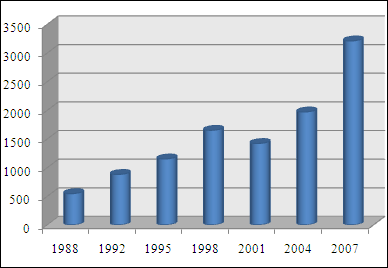
Main foreign exchange market turnover, 1988 - 2007, measured in billions of USD.
As such, it has been referred to as the market closest to the ideal perfect competition, notwithstanding market manipulation by central banks. According to the Bank for International Settlements,[2] average daily turnover in global foreign exchange markets is estimated at $3.98 trillion. Trading in the world's main financial markets accounted for $3.21 trillion of this. This approximately $3.21 trillion in main foreign exchange market turnover was broken down as follows:
-
- $1.005 trillion in spot transactions
- $362 billion in outright forwards
- $1.714 trillion in foreign exchange swaps
- $129 billion estimated gaps in reporting
Trading Software
 Since its inception, CMS Forex’s VT Trader™ has been a
 comprehensive and easy to use Forex trading toolkit and
a pioneer in the industry.
a pioneer in the industry.
Easy access to powerful tools
Highly developed charting technology
Advanced customization
Reuters news and market analysis
Sophistication and convenience set VT Trader™ apart from other Forex trading software.
Learn Forex
 FOREX (the Foreign Exchange market) is an international market where participants speculate on the value of different currencies, buying and selling dollars, pounds, euros, and other currencies.
 There are only a few major currencies to follow, compared to hundreds of stocks in the equities market. In order to get started understanding Forex, sign up for a free practice account today and learn as you trade!
Trading risk free with a practice account is the best way to get familiar with this ever-growing market. And once you are signed up, CMS Forex will provide you with thorough educational resources to guide you along the way.
So don't wait, take this opportunity to get started trading Forex!
Not enough time for finance ministers and central bankers
 For how long do policy-officials need to get financial expansion and steady the economic markets? If the international leaders are not able to reach an important, joint policy response to the world’s slump, the situation most likely to get poorer. How much worse? These are the most popular and should-be popular questions the market is struggling with currently; and throughout the coming weeks and months, traders ought to very carefully examine and pay a very close attention on ‘just how bad can things actually become.’ While the fundamental position for general risk trends is not hopeful, carry interest got a major increase this past week. The Index went up more than 650 points from last Friday, indicating a important break above resistance in the force-ridden.
Forex Basics
 The following is an introduction to some of the basic terms and concepts used in forex trading.
 Foreign Exchange : The simultaneous buying of one currency and selling of another.
Foreign Exchange Market : An informal network of trading relationships between the world's major banks and other market participants, sometimes referred to as the 'interbank' market. The foreign exchange market has no central clearinghouse or exchange, and is considered an over-the-counter (OTC) market.
Spot Market : Market for buying and selling currencies for settlement within two business days (the value date). USD/CAD = 1 day. Most dealers will automatically roll over your open positions, allowing you to hold a position for an indefinite period of time.
Rollover : The process whereby the settlement of a transaction is rolled forward to the next value date. The cost of this process is based on the interest rate differential between two currencies.
Exchange Rate : The value of one currency expressed in terms of another. For example, if the exchange rate for EUR/USD is 1.3200, 1 Euro is worth US$1.3200.
Currency Pair : The two currencies that make up an exchange rate. When one is bought, the other is sold, and vice versa.
Base Currency : The first currency in the pair.
Counter Currency : The second currency in the pair. Also known as the terms currency.

USD = US Dollar
EUR = Euro
JPY = Japanese Yen
GBP = British Pound
CHF = Swiss Franc
CAD = Canadian Dollar
AUD = Australian Dollar
NZD = New Zealand Dollar
Currency Pair Terminology
EUR/USD = "Euro"
USD/JPY = "Dollar Yen"
GBP/USD = "Cable" or "Sterling"
USD/CHF = "Swissy"
USD/CAD = "Dollar Canada" (CAD referred to as the "Loonie")
AUD/USD = "Aussie Dollar"
NZD/USD = "Kiwi"
The following pairs might also be referred to by the following nicknames:
EUR/USD = "Fiber"
USD/JPY = "Gopher"
EUR/GBP = "Chunnel"
GBP/CHF = "Geppy"
Market Maker :A market maker makes a market for a particular financial instrument, providing liquidity and a two-way price quote. A market maker takes the opposite side of your trade.
Broker : A firm that matches buyers and sellers for a fee or a commission.
Counterparty : One of the participants in a transaction.
Sell Quote : The quote on the left is the price at which you can sell currency. (Also known as the bid price). e.g. For EUR/USD 1.3200/03, you can sell 1 Euro for US$1.3200.
Buy Quote : The quote on the right is the price at which you can buy currency. (Also known as the ask or offer price). e.g. For EUR/USD 1.3200/03, you can buy 1 Euro for US$1.3203.
Spread : The difference between the sell quote and the buy quote. If the quote for EUR/USD reads 1.3200/03, the spread is 3 pips. In order to break even, the currency must shift in your direction by an amount equal to the spread.
Pip : Price Interest Point. The smallest price increment a currency can make. Also known as points. e.g. 1 pip = 0.0001 for EUR/USD, or 0.01 for USD/JPY.
Pip Value : The value of a pip. 1 pip = $10 for EUR/USD, GBP/USD, AUD/USD & NZD/USD with 100k lots, or $1 per pip with 10k lots. To calculate the pip value of other currency pairs, use a pip value calculator .
Tick : Minimum change in price
Lot : The standard unit size of a transaction. Typically, one standard lot is equal to 100,000 units of the base currency, or 10,000 units for a mini.
Standard Account : Trading with standard lot sizes
Mini Account : Trading with mini lot sizes
Margin : The deposit required to open a position. A 1% margin requirement allows you to open a $100,000 position with a $1,000 deposit.
Leverage : The amount of times the value of your transaction exceeds your margin. e.g. 100:1 leverage implies a 1% margin.
Long Position : A position whereby the trader profits from an increase in price. (Buy low, sell high)
Short Position : A position whereby the trader profits from a decrease in price. (Sell high, buy low)
Market Order : An order at the current market price
Entry Order : An order that is executed when the price touches a pre-specified level
Limit Entry Order : An order to buy below the market or sell above the market at a pre-specified level, believing that the price will reverse direction from that point.
Stop-Entry Order : An order to buy above the market or sell below the market at a pre-specified level, believing that the price will continue in the same direction from that point.
Limit Order :An order to take profits at a pre-specified level
Stop-Loss Order : An order to limit losses at a pre-specified level
OCO Order : One Cancels Other. Two orders whereby if one is executed, the other is cancelled.
Manual Execution : The order is executed with human intervention.
Automatic Execution : The order is executed automatically by computer without human intervention or involvement.
Slippage : The difference in pips between the order price and the price the order is filled at.
Example Transaction : Assume you have a trading account of $20,000 and you have chosen to use 100:1 leverage on your account. The current quote for EUR/USD is 1.3225/28. You place a market order to buy 1 lot of 100,000 Euros at 1.3228, expecting the euro to strengthen against the dollar. At the same time you place a stop-loss order at 1.3203, and a limit order at 1.3328.
The value of this trade is $132,280 (100,000 * 1.3228) but because you are using 100:1 leverage, you only need to deposit 1% of the total, which is $1322.80 ($132,280 * 0.01).
The Euro strengthens against the dollar as expected, rising to 1.3328 where your limit order is reached. Your position is closed. You have made 100 pips.
Your total profit for this trade is $1,000 (100,000 * (1.3328 - 1.3228)), and the return on your investment is 75.6% ($1000/$1322.80).
Trade Summary :
| Opening Balance: | $20,000 |
| Leverage: | 100:1 |
| Buy: | 1 std lot EUR/USD @ 1.3228 = $132,280 |
| Margin Requirement: | $1322.80 |
| Position Size: | 6.6% of the account ($1322.80/$20,000) |
| Pip Value: | 1 pip = $10 |
| Stop-Loss: | 25 pips (representing 1.25% of the account) |
| Limit: | 100 pips |
| Risk/Reward Ratio: | 4:1 |
| Sell: | 1 std lot EUR/USD @ 1.3328 = $133,280 |
| Profit: | $1,000 |
| Return: | 75.6% ($1,000/$1322.80) |
| Closing Balance: | $21,000 (+5% gain) |
Subscribe to:
Posts (Atom)